Hot take: most “pressure washing damage” stories aren’t about bad luck. They’re about using the wrong tool because it *felt* faster.
If you’ve ever watched a neighbor carve tiger stripes into their driveway or blast paint off trim, you already know how this goes. The goal isn’t maximum force. The goal is a clean surface that still looks like itself afterward.
One-line truth:
Clean doesn’t count if you wreck the substrate.
So what’s the difference, really?
Pressure washing is brute force: high PSI water does the heavy lifting by physically knocking grime loose.
Soft washing is chemistry + patience: low pressure delivers a cleaning solution that breaks down organics (algae, mildew, lichen), then you rinse it away without sandblasting your house. That distinction matters even more on delicate materials like shingles, if you’ve ever wondered should roofs be pressure-washed?, the short answer is that many roofs are better suited to soft washing.
That’s the headline. But the practical choice comes down to two things:
– Surface tolerance (can it handle force?)
– Stain profile (is it dirt, oil, minerals, or living growth?)
Get those wrong and you’ll be cleaning the same area again in six months… or paying for repairs.
Pressure Washing: what’s happening at the nozzle (and why tips matter)
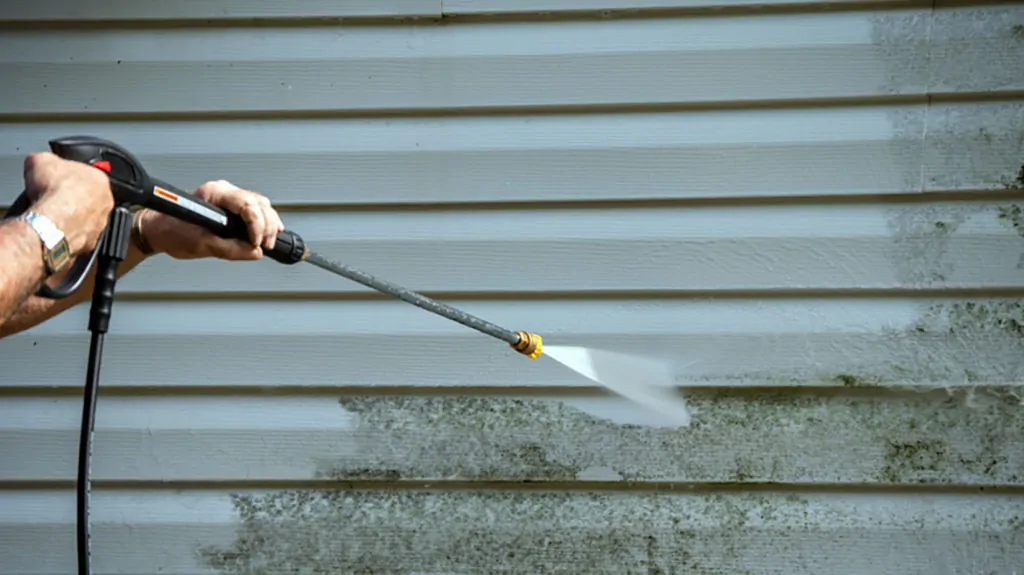
Pressure washers don’t “clean” so much as transfer energy. PSI is the pressure, GPM is the volume, and the nozzle shape determines how that energy hits the surface.
A narrow tip concentrates force into a tiny area. Great for chewing gum on concrete. Terrible for wood grain and older mortar.
Here’s the part homeowners overlook: distance is a setting. Backing up even a foot can dramatically reduce how aggressive the spray is. I’ve seen people chase a stain by moving closer and closer, and that’s when etching, fuzzing, and striping happens.
A few practical mechanics (the specialist briefing version):
– PSI drives impact; GPM drives flushing power. Two machines can have similar PSI and wildly different real-world performance.
– Spray angle changes risk. A 0° tip is basically a water chisel. A 25° or 40° spreads the load.
– Hot water helps on grease and certain organics. It’s not magic, but it can reduce chemical need and dwell time.
Now, this won’t apply to everyone, but if you’re relying on pressure alone to remove algae from siding, you’re choosing the slow, risky method. Organics respond better to soft wash chemistry than to raw force.
Soft Washing: gentle pressure, heavy results
Soft washing is what I reach for when the surface is:
– painted
– porous
– older
– prone to delamination
– or just expensive to replace (hello, roof)
Instead of trying to “blast off” growth, you’re killing and loosening it. That’s why soft washing often stays cleaner longer. You’re not only removing the visible layer; you’re treating the organism causing the stain.
Look, some folks assume soft washing is “just rinsing with soap.” It isn’t. Done correctly, it’s controlled application, correct dwell time, and a thorough rinse that doesn’t drive water behind siding or under shingles.
And yes, detergents matter. Biodegradable doesn’t automatically mean plant-safe at any concentration (that’s the part marketing leaves out).
Question: Are you cleaning dirt… or biology?
If the stain is alive or used to be alive, pressure washing is usually the wrong first move.
Stain profile cheat sheet (quick and usable)
– Green film, black streaks, fuzzy patches→ algae/mildew/lichen
Soft washing wins. Pressure can remove it, but it often comes back faster.
– Grease, tire marks, shop spills on concrete→ petroleum-based grime
Pressure + degreaser (often hot water if you have it) is the efficient path.
– White crusty buildup→ mineral deposits/efflorescence
This is chemistry-forward, not pressure-forward. Too much PSI can pit concrete or scar brick.
– Ground-in soil on hardscape→ plain dirt
Pressure washing is fine if the surface is durable.
Surface type: the “don’t regret this later” guide
Some materials forgive you. Others keep receipts.
Concrete & pavers
Pressure washing works well here, but streaking is common when people stop and start in the same lane. Keep the wand moving, overlap passes, and consider a surface cleaner attachment if you want uniform results.
Brick & older mortar
Brick faces can handle pressure. Mortar joints, especially older ones, often can’t. If joints are already sandy or cracked, soft wash first, then rinse gently. I’ve seen beautiful brick turned into a crumbly mess because someone treated it like a driveway.
Vinyl siding
Soft wash almost every time. Vinyl can flex, trap water behind panels, and oxidized vinyl can get that chalky smear if you go too hard.
Painted wood, trim, soffits
Soft wash. Pressure can lift edges, drive water behind boards, and peel paint in sheets. (Sometimes that reveals a paint failure you needed to address anyway, but you don’t want to “discover” it mid-wash.)
Decks and fences (wood)
This is where people do the most damage. Too much pressure raises the grain and leaves it furry. Then you’re sanding, surprise project. Use cleaner chemistry, low pressure, and rinse with restraint.
Roof shingles
Soft wash only. High pressure can strip granules and shorten roof life. Insurance adjusters have seen it all.
Prep isn’t glamorous, but it’s where pros win
Most DIY failures aren’t because the machine was weak. It’s because prep was sloppy.
A tight prep routine looks like this:
– Clear loose debris (broom/blower beats blasting leaves into corners)
– Pre-wet plants and soil; cover delicate landscaping if you’re using stronger mix
– Protect outlets, doorbells, cameras, vents, and any gaps where water can intrude
– Test a small hidden area for colorfastness and surface reaction
– Plan rinse direction so dirty runoff doesn’t redeposit
One more thing: don’t aim high-pressure spray at windows, door seals, or weep holes. That’s not cleaning. That’s inviting leaks.
Tools, tips, and the “I didn’t think of that” safety stuff
Pressure washers are powerful enough to inject water into skin. That’s not a scare tactic, it’s a real injury category.
If you’re doing this yourself, at minimum:
– eye protection
– gloves with grip
– closed-toe, non-slip footwear
– awareness of ladders (I don’t love ladders + pressure wands, awkward recoil and bad angles)
For nozzles, general rules that keep people out of trouble:
– Start wider (25°/40°) and step up only if needed
– Keep distance, adjust gradually
– Avoid 0° tips unless you actually know why you’re using one
Cost and ROI: the part nobody thinks about until they repaint
Pressure washing is often cheaper per visit and faster on hard surfaces. Soft washing can cost more upfront, but it typically reduces repeat growth and lowers the chance you’ll be patching paint, replacing wood fibers, or re-pointing mortar.
A real stat to anchor the “biological growth” discussion: the EPA notes that moisture control is key to preventing mold growth indoors, and visible mold can begin growing on damp materials within 24, 48 hours under the right conditions (U.S. Environmental Protection Agency, “Mold Cleanup in Your Home”). Outdoor growth isn’t identical, but the principle holds: moisture + organics + time equals recurring staining if you don’t treat the cause.
In my experience, the best “value” isn’t the cheapest wash. It’s the method that lets you go the longest without doing it again, and doesn’t create a repair bill.
My rule of thumb (opinionated, but it works)
If you’d be upset to damage it, start with soft washing.
You can always escalate pressure carefully. You can’t un-etch concrete, un-fuzz a cedar deck, or un-strip granules from a roof once they’re gone.
When in doubt: match the method to the surface, treat organics like organics (not like dirt), and don’t confuse aggression with effectiveness.





 Amanita muscaria, often referred to as the fly agaric mushroom, has a long and storied history as a potent symbol of mysticism and altered states of consciousness. These vibrant red and white mushrooms with their distinctive appearance have been used for centuries by various cultures to access what can only be described as the mystical realms of the mind. Amanita muscaria is a unique species of mushroom that contains psychoactive compounds, most notably muscimol and ibotenic acid. While it lacks the popularity of its psychedelic cousins like psilocybin-containing mushrooms or LSD, it holds a special place in the world of psychonauts and those seeking altered states of consciousness. The use of Amanita muscaria dates back thousands of years, with indigenous Siberian tribes being among the first to incorporate it into their rituals. These tribes would consume the mushroom to connect with their spiritual ancestors and seek guidance from the spirit world. The mushroom’s effects were seen as a gateway to the divine, a bridge between the ordinary and the extraordinary.